Why Reading & Literacy are important?
-900x506.webp)
Why is Reading important?
Reading is one of the first things that we are taught in school and forms a fundamental part of our subsequent learning. Literacy is key to accessing a huge amount of the content taught in the curriculum and fluent reading often underpins how students can then write or speak to express themselves. Indeed, students with lower literacy levels at secondary school will find that this impacts their learning in subjects such as Mathematics and Science as well as English. It is estimated that a reading age of 15 years and 7 months (GL Assessment) is needed to access and understand the vast majority of GCSE exam papers and content. Therefore, being able to read fluently has a direct effect on students’ ability to access GCSE content (across subjects) and can have a positive effect on their final attainment!
In 2022, only 1 in 2 young people said that they enjoy reading (National Literacy Trust), this is the lowest number on record. Whilst reading is an essential skill in terms of necessity, it is also important to read for pleasure (Open University). Fostering a love of reading from an early age can help young people to develop into more rounded adults. Reading widely and for pleasure helps children to develop empathy and social skills through exposing them to different perspectives and characters. In a hugely multicultural school this is an invaluable opportunity. Moreover, reading stimulates your brain, improves your memory and helps you to think creatively and critically. As well as this, research suggests that reading for 30 minutes a week increases health and wellbeing. Reading for pleasure has been found to improve our confidence and self-esteem, providing the grounding we need to pursue our goals and make life decisions. It can also aid our sleep and reduce feelings of loneliness. Most importantly, reading for enjoyment can reduce young people’s stress by up to 68% and can be a valuable ‘escape’ from life stresses!
How can I support my child to enjoy reading?
- Turn subtitles on the TV!
- Allow them choice – reading is reading!
- Read with them – whether this is reading the same book or actually reading aloud!
- Audiobooks – research shows that listening to texts can still improve literacy!
- Embed good habits – read for 5 mins a night and build it up!
Year 7-9 Reading Plus Programme
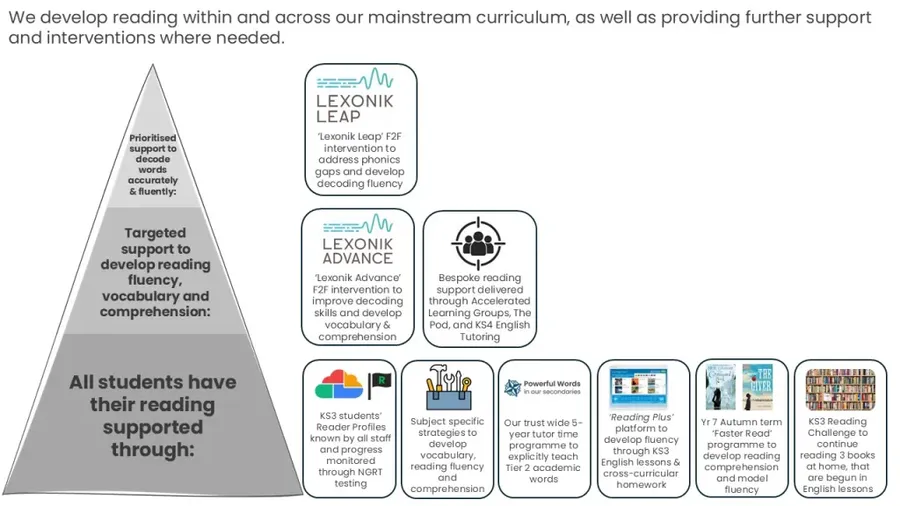
Reading Plus is a literacy program that aims to support young people in becoming better readers. The program helps students to develop the skills they need to become proficient readers and lifelong learners. Through regular practice, reading will become easier, comprehension will increase, and students will make meaningful connections between reading and learning.
Each week students have the freedom to explore texts of their choice through the assigned reading and vocabulary lessons. They complete these lessons to earn combos and level up the difficulty and choice of the texts they can read. From their dashboard, students can track how many words they have read and where they are in achieving their reading goals!
To support students with taking full advantage of the program, students have 1 English lesson per week to access Reading Plus and complete their lessons.
To achieve the full benefits of the programme, students are expected to complete all their weekly assigned reading and vocabulary lessons. This is approximately 90 minutes a week, of which 55 mins can be achieved in students’ once-a-week Literacy lesson. The remaining time is set as a weekly homework through English teachers. Research has shown that – if used as intended – the Reading Plus programme can yield up to 2.5 years’ worth of reading progress in only 60 hours of use! Alongside supporting progress in fluency and comprehension, the programme has shown that it can also increase confidence and motivation to read for pleasure. Reading Plus | Online Reading Programme | Reading Solutions
The School Reading Challenge -KS3
This year has seen the revival of the Key Stage 3 Reading Challenge!
Throughout the academic year, Key Stage 3 students will have the opportunity to read three texts supplied by the school with the aim that they will finish the academic year having read a minimum of three books solely for enjoyment! Each term, students will start reading the text in class with their English teachers and then take home a copy of the text to finish reading it themselves.
Our aim with the KS3 reading challenge is to help students to become more fluent readers but also to give them access to stories and books outside of an academic ‘English’ context. We want our young people to read a story simply to enjoy it and for stories to help create well-rounded members of the community.
The Faster Reading Project
This initiative was is based a study from the University of Sussex in 2015 which involved English teachers reading two whole novels at a faster pace than usual in 12 weeks, yielding valuable gains in terms of reading age .The idea was to just read, without stopping every few pages to do analysis, questions or writing. Teachers found pupils were motivated through quickly reading a whole text. It was found that reading two challenging novels back to back enabled all readers to make rapid progress.
We did the Faster Read with our years 7s earlier in the year and are now planning the project with the year 8s in the summer term. Our aim is to immerse the students in literature thus facilitating greater fluency, ability to disseminate texts and to inspire an overall love of reading. Students were very positive about the experience and we hope for the same results with our year 8s. We will be testing reading scores in the coming weeks to evaluate progress, although we believe we have been successful in inspiring more of our young people to read regularly.
Faster Reading Project Reviews from our students!
“I really enjoyed just being able to sit with a story and like it without needing to explain!”
“There were lots of new words that I discovered, which has made me curious.”
“It made me feel very peaceful and my imagination got to run wild!”
“My favourite was The Graveyard Book; I liked learning about Bod’s slightly strange world.”
Useful Workbooks and Links for helping with writing accuracy
Literacy and English – BBC Bitesize
Secondary Free Resources & Home Learning | CGP Books
Want to learn more about Literacy and the importance of Reading?
What is Literacy? | National Literacy Trust | National Literacy Trust
Reading For Pleasure – Reading for Pleasure (ourfp.org)
Where can I find suggestions of what to read?
Ask in bookstores or at your local library, alternatively you could search here:
BOOK RIOT – Book Recommendations and Reviews
Lit in Colour | Supporting inclusive reading in schools (penguin.co.uk)
50 best YA books to read right now – Pan Macmillan
Books for KS4 – recommendations for 14-16 year old young adults (schoolreadinglist.co.uk)
Teen books | Books | The Guardian
Reading suggestions from North Cambridge Academy’s teachers:
- How Music Works – John Powell
- The Musical Human: A History of Life on Earth – Michael Spitzer
- Why We Sing – Julia Hollander
- Musicophilia – Oliver Sacks
- Alex’s Adventures in Numberland – Alex Bellos
- Numbers Don’t Lie – Vaclav Simil
- The Maths that Made Us – Michael Brooks
- Dezeen Book of Ideas (Architecture Interior) – Dezeen Magazine
- How was that built – Roma Agrawal
- The Design of Everyday Things – Don Norman
- Zaha Hadid – Phili Jodidio
- How to Draw Architecture – Marcus S Agerer
- Observational Sketching by Mariko Higaki
- The 39 Steps – John Buchan
- After the First Death – Robert Cormier
- Revolver – Marcus Sedgwick
- Boy and Going Solo – Roald Dahl
- Moab is my Washpot – Stephen Fry
- Touching the Void – Joe Simpson
- Cider with Rosie – Laurie Lee
- Angela’s Ashes – Frank McCourt
- Failosophy for Teens – Elizabeth Day
- Heartstopper – Alice Oseman
- The Hunger Games Trilogy – Suzanne Collins
- Wrath – Marcus Sedgwick
- The Climbers – Keith Gray
- A Tempest of Tea – Hafsah Faizal
- Bitterthorn – Kat Dunn
- I Must Betray You – Ruta Sepetys
- Is there anybody out there? – Dara O’Briain
- The Moonstone – Wilkie Collins
- Lord of the Flies – William Golding
- Brighton Rock – Graham Greene
- The Go-Between – L.P. Hartley
- The Old Man and the Sea – Ernest Hemingway
- The Dubliners – James Joyce
- Cane Warriors – Alex Wheatle
- Things a Bright Girl Can Do – Sally Nicholls
- Goodnight, Boy – Nikki Sheehan
- Illuminae – Amie Kaufman & Jay Kristoff